
Spring 2027 and Beyond
The CS department is introducing new and better pathways to learn CS. Our new courses will build on students' existing knowledge, promote student success, and offer meaningful new opportunities for students across SAS to add programming, computational thinking, and AI literacy to their skill set. We want everybody to know what's changed. Here's a guide:
For prospective CS majors
You can get transfer and AP credits more straightforwardly. We will not have weed-out courses. In the courses you do take, you will learn state-of-the-art ideas with state-of-the-art tools, while mastering the fundamentals.
For students interested in adding CS to a liberal arts education
You can now learn programming in a way that makes meaningful connections to the increasing role of CS across natural science, social science, and humanities, and gives you an open-ended avenue to add targeted CS knowledge in pursuit of your other interests.
For prospective employers
We will make sure students that pass this coursework have accomplished key learning goals. They will be able to do more powerful things with their knowledge of modern tools, including AI, and they will also know what AI can't do. Please reach out if you are interested in exploring experiential learning opportunities with CS and SAS.
For advisors
Advanced Placement Computer Science
-
- An AP CSA score of 4 grants equivalency for CS120, making the student eligible to register for CS121. No CS credit awarded.
- An AP CSA score of 5 grants equivalency for CS121, making the student eligible to register for CS122. Credit for CS 121 awarded.
- An AP CS Principles score of 4 or 5 grants equivalency for CS110.
Placement Exam
Students who did not take the AP CSA exam or scored lower than a 4 wishing to register for CS120 or CS121 must first take an online placement exam, and their score determines which of the two courses they are eligible to register for.
Students are given up to two attempts per admission cycle to pass the exam to be granted equivalency for CS120. If a student does not pass on the first attempt, they may retake the exam one additional time. The retake window opens 24 hours after the first attempt and stays open for 7 days. We encourage students to take the exam as soon as it opens:
-
- Students wishing to register for the Fall semester may take the exam between March and September (see add/drop period).
- Students wishing to register for the Spring semester may take the exam between October and January (see add/drop period).
The exam can be accessed at https://placement.elearning.rutgers.edu/login, and the results will be posted on the Degree Navigator site within 24 hours.
Transfers entering in Fall 2027 and later
Students who received credit for CS111 will receive credit for CS121, and students who received credit for CS112 will receive credit for CS122.
Re-enrolling students with D/F in CS111 and CS112
The department will not offer CS111 starting Spring 2027 and CS112 starting Fall 2027. Students who receive a D/F in CS111 in Fall 2026 may, with an advisor’s guidance, choose to take either CS120 or CS121 in Spring 2027. Students who receive a D/F in CS112 in Spring 2027 will take CS122 in Fall 2027. The SAS repeated course policy applies.
Pre-Requisites
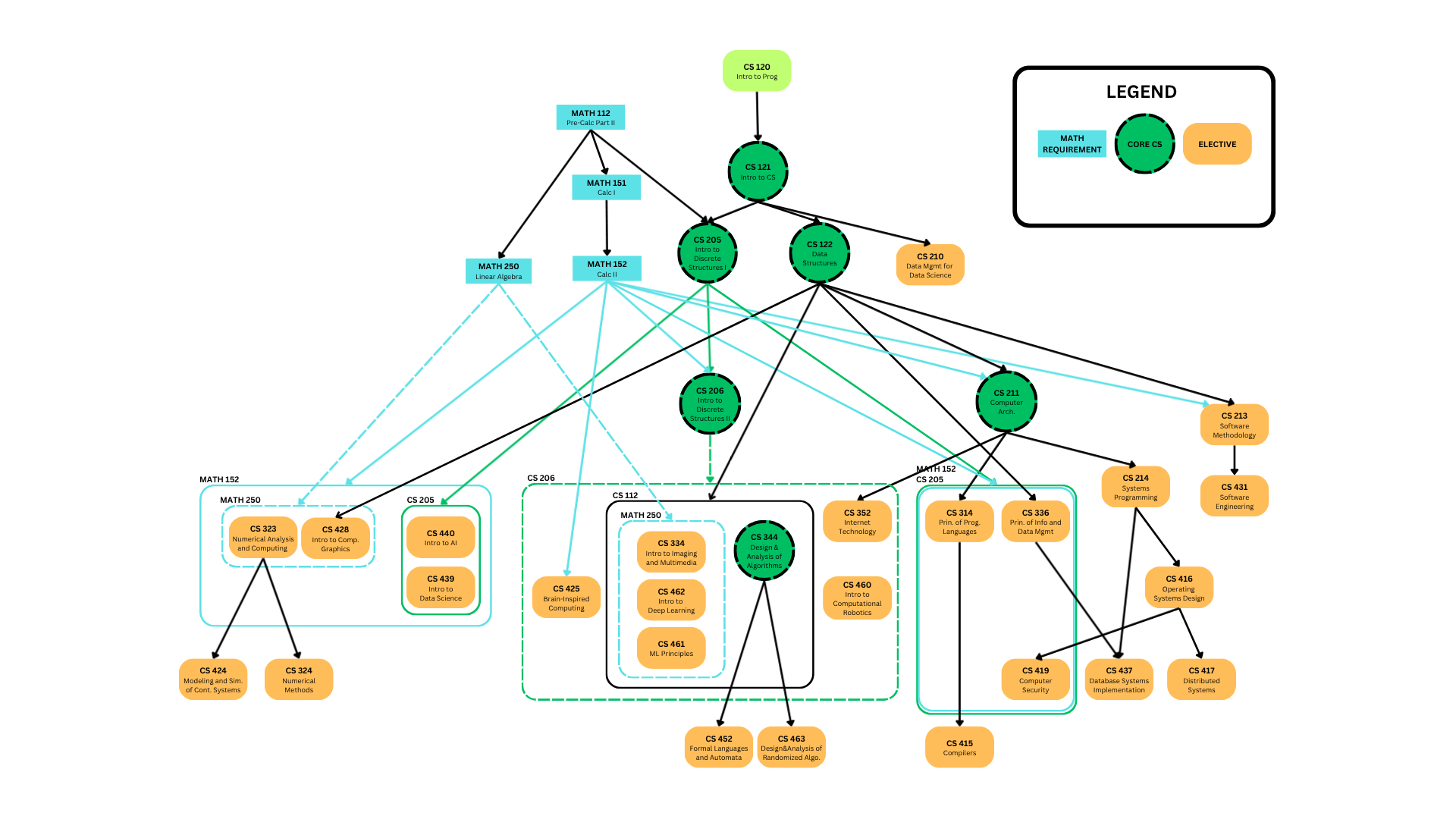
CS courses with CS112 as a pre-requisite will have CS122 as a pre-requisite.
For CS faculty and Partner programs
The department is retiring CS111 and CS112 and, in their place, introducing three new courses that will provide students with the fundamental skills and concepts of Computer Science:
CS120: Introduction to Programing (QR, QQ) (4 credits)
This course introduces algorithmic thinking, enabling students to think critically to develop solutions to problems using a computational approach. There will be an emphasis on writing, testing, and debugging programs, documenting and explaining code, including critical AI literacy for CS. Students do not receive CS major credit for this course.
CS121: Introduction to Computer Science [QR, QQ] (4 credits)
This course introduces analysis of program efficiency, searching and sorting, recursion, objects, inheritance, interfaces, and generic data types, and emphasizes practical problem-solving skills, including design, testing, and debugging.
CS122: Data Structures (4 credits)
This course surveys important data structures and teaches students to compare, select, modify, and combine them to build complex implementations that meet specified performance requirements.
For additional information contact the CS undergraduate director.
Reasoning for the Change
The new courses will strengthen our students' preparation. The new mix of material gives students time to consolidate their learning, while covering important additional skills and concepts in program design and analysis, data-informed programming, the expression of computational ideas for teamwork, and the inclusion of AI tools. The courses will adopt a mastery-based grading approach, which avoids partial credit for incorrect work, ensuring that students can earn a grade of C or better only if they have mastered key learning goals.
The new courses will streamline paths through the major. A three-course sequence aligns with instruction at peer institutions and better reflects students’ experience with CS in high school and two-year colleges. We anticipate that many first-year students will place out of CS120 as determined through a mandatory proficiency exam administered by the Computer Science Department. CS120 will be a prerequisite for CS121, with students receiving SAS credit but not CS credits towards the CS major. Therefore, the number of CS electives for majors and the number of electives that majors can take from outside the department remain unchanged. Students who take CS120 may choose to pursue a BA instead of a BS degree if the additional course interferes with other educational goals, such as a double major. However, most students can take more than 120 credits to graduate without any additional financial burden. Therefore, taking CS120 will not prevent students from pursuing a BA or BS degree, but will lead to a better learning experience and as a result a higher success rate in our major.
As we offer these courses, we will continue our efforts to support students with clear, consistent course organization and resources, learning assistants, and advising. We will continue to refine the courses based on data tracking of student success across demographics. We are optimistic that introducing the three-sequence course and providing a range of entry points will make the courses more accessible and appealing.